
Frontier Kindred
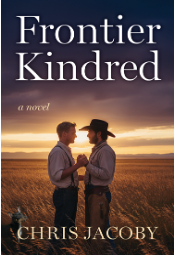
Set against the rugged backdrop of the American frontier, Frontier Kindred is a heartfelt story of love, resilience, and identity. In this Q&A, I share some of the inspiration behind the story, how the characters came to life, and what it means to craft a western that reflects the heart of queer experience.
✦ ✧ ✦
Frontier Kindred blends western grit with LGBTQ+ themes. What inspired you to bring those two genres together?
The inspiration actually came from my husband, John. He thought it would be really powerful to see a western built around a gay romance, with all the conflict that would naturally come with it. I took that simple but striking idea and ran with it, shaping it into the story that became Frontier Kindred.
The novel explores love, resilience, and survival in the face of prejudice. What do you hope readers take away from Nate and Jack’s story?
At it’s heart, I hope readers embrace the theme of resilience in the face of prejudice. I wanted this story to inspire people to hold fast to their identity and truth, no matter the hardships they face. That’s why I chose this particular setting—because if these characters can endure and still find love and belonging in such a hostile environment, it reminds us that anyone can.
How did you balance historical authenticity with telling a story that resonates with modern readers?
I made a conscious effort to ground the story in authenticity at every level—whether it was the setting, the characters, or the emotions they carried. When it came to the romance arc, I didn’t want it to feel forced or stylized. Instead, I let it unfold in the same way modern love does: with hesitations, discoveries, vulnerability, and courage. Because of that, the relationship between Nate and Jack flowed naturally, even with the challenges of their time. And I think that dynamic resonates with modern readers.
Nate is introduced as a young schoolteacher burdened by responsibility. How much of his character reflects your own experiences?
Quite a bit, honestly. While Nate isn’t me, I did draw on some of my own experiences when shaping him. Like Nate, I’ve always felt the pull between personal dreams and the responsibilities life hands you. He’s a young man who had to give up a career path he loved in order to support his family, and that sense of sacrifice is something I deeply connect with. I also poured some of my own introspection into him—the way he second-guesses himself but still finds the courage to keep going. In that sense, Nate is both his own character and a reflection of parts of me.
Jack’s guarded, rugged nature contrasts with Nate’s sense of duty and hope. How did you approach writing their relationship?
I saw Jack’s guarded, rugged presence as the perfect complement to Nate’s earnestness and sense of duty. They’re different in many ways—Jack carries himself with caution, while Nate tends to look ahead with determination—but I wanted those differences to highlight, rather than divide them. At the same time, I built their connection on shared human qualities: compassion, loyalty, and the capacity to love deeply. Those similarities allow them to meet in the middle. In the end, their contrasts bring balance, while their shared core makes their bond unshakable.
The supporting cast—Lillian, Eleanor, Abel, Ben—adds so much depth. Did any of them surprise you and grow larger than planned?
Absolutely. Eleanor was the biggest surprise and probably my favorite creation. At first, I had a completely different direction in mind for her. Then one morning, it just clicked—I realized the story needed a special, unshakable ally for Nate, someone who could anchor him in a way no one else could. From there, the idea of a maternal figure took shape, and Eleanor fit perfectly. She became so much more than I had planned, and I absolutely love the role she plays in the story.
Silver Creek feels like a living, breathing frontier town. What kind of research did you do to capture its details?
I did a ton of online research—and honestly, it was one of the most enjoyable parts of writing this book because I learned so much along the way. I dug into everything from the layout of 19th-century frontier towns to the clothing people wore, the way schools operated, and the social norms of the time. Even dialogue—I wanted the way people spoke to feel authentic without being too stiff. Every little detail helped bring Silver Creek to life, and I loved weaving those discoveries into the story.
Historical touches like the U.S. Centennial and references to events like the Grasshopper Plague ground the story. How did you decide what real history to weave in?
There’s actually a funny story here. When I was a few chapters in, I was about to write in a Fourth of July scene as if it were any other year—then it hit me: oh my gosh, it’s the Centennial year. So, I had to backtrack and weave in a proper celebration to honor the occasion, which turned out to be one of my favorite historical details in the book. For other touches, like the Grasshopper Plague, I did extensive research into events that could have impacted farms and ranches at the time. At first, I thought I might have to rewrite parts of the story to reflect widespread devastation—but then I discovered something fascinating: the plague didn’t strike every farm equally. Some were completely wiped out, while others just a few miles away were spared. That simple fact gave me the freedom to acknowledge the event authentically without derailing the plot I’d already built.
Which scene was the most emotional and challenging for you to write?
That’s a tough one because there were several moments that carried a lot of emotional weight. But if I had to choose, it would be the scene where Samuel dies. Writing his death—and capturing Nate’s and Lillian’s grief in a way that felt raw, believable, and deeply human—was incredibly difficult. I wanted readers to feel the devastation of that loss right alongside them. There were other scenes that challenged me on an emotional level too, but Samuel’s death was by far the hardest to bring to life.
Frontier Kindred is the first in a trilogy. Without spoilers, what can readers expect as the story continues?
When I finished writing Frontier Kindred, I realized there was still so much left to tell about Silver Creek and its people. Nate and Jack’s journey was just beginning, and I wasn’t ready to leave them—or the town—behind. The next book will dive deeper into their relationship while also exploring the bonds within their circle of friends and the wider community. Readers can expect new faces, new challenges, and of course, conflict and tension that will test both love and loyalty.
Will Ryder the dog return in future books?
Absolutely. Ryder is an important part of the entire trilogy. He’s based on my real dog, Ryder, who also appears on the cover of Frontier Kindred as a tribute to my faithful companion. My cover designer even incorporated an actual photo of him into the artwork, which was such a special touch. So yes—readers can look forward to Ryder being a steady presence as the story continues.
